<Preface>
In the digital transformation era triggered by the Fourth Industrial Revolution, we need a good government that is open-minded, problem-solving, and satisfying to the people. This is only possible through accumulating and disclosing data that everyone can relate to, a public discussion process, and fair and transparent enforcement. In the era of self-governance, we need an open and smart government that can present seemingly feasible policies based on high expertise and accurate future forecasting, as well as conflict management and support. The government must provide a platform for a hyper-connected, socialized sharing economy that goes beyond simply being an intermediary service that connects surplus resources and services through social media. The government, businesses, and people of Korea should be able to access the country's human and material resources anytime, anywhere, and through various access methods, where breakthrough ideas and concrete commoditization and servitization are discussed and traded daily. Such a strategy is an appropriate alternative for a country like Korea, which has a successful track record in the information society and e-government. However, the centralized approach of the past should not be repeated. In the future, the government should play the role of catalyst, enabler, and mediator between public and private markets based on expertise and communication. It should seek to create a better environment for successful domestic companies to enter the larger global market and a truly public role for small and medium-sized enterprises, youth, and vulnerable groups frustrated by repeated failures, giving them a second chance and a platform for hope. We need open policies and smart government for 21st-century coexistence, and this is the basic foundation for government innovation based on digital platforms that people can relate to.
Future societies share a common goal of reconciling ideals and reality, a citizen-centered state, ubiquitous digitalization, artificial intelligence (AI) as water, data-driven work and policies, and open, community-oriented societies. In recent years, "agile" business management strategies have emerged as a keyword for the organizations of the future. Quick decisions and consensus building summarize agile management, rapid planning and experimentation of ideas, correction through failure, platform-centered production and consumption sharing networks, and utilization of digital convergence technologies. It emphasizes meeting frequently to make decisions and take action. It prefers simple, clear strategies and tangible rewards that excite and move the organization and its people rather than creating new organizations. Globally, future societies share a common vision of a citizen-centric state, digital ubiquity, easy use of artificial intelligence (AI) across all sectors of society, data-driven practices and policies, and open, community-driven societies. In this regard, "agile" and "nudge" strategies have recently emerged as keywords for future policymaking and organizational operations. Agile techniques are summarized as quick decisions and consensus building, rapid planning and experimentation of ideas, correction through failure, platform-centered production and consumption sharing networks, and utilization of digital convergence technologies. Nudge strategies emphasize that "gentle interventions that guide people's choices" are paramount in actual policy processes and organizational operations and highlight the role of the "choice architect," the person who creates the "context" for people to make decisions. The untact era caused by the Fourth Industrial Revolution and COVID-19 demands talented people who can grasp the big trends of the times based on accurate data analysis and communication skills to make timely decisions and implement them.
To reach the world-class level, Korea's e-government needs to develop by implementing user-oriented or customer-centered e-government services and including all classes and members of society. In the past, efforts have been made to implement e-government. Still, the process of reflecting the needs of the service's customers by building a system centered on the provider has been insufficient. It is because e-government has been focused on quantitative growth, such as infrastructure expansion, salinization of administrative services, and development of new administrative services, and the way to improve the public's awareness and utilization of e-government services has been focused on simply increasing the number of services. Developing and implementing community e-government services must avoid making the same mistakes. To plan and build community e-government services close to residents, it is necessary to provide services by simply converting existing administrative services into platform-type services centered on the cloud. Implementing e-government services in a way that unilaterally provides services that the provider considers important should be avoided without identifying customer demand for the existing administrative services. Therefore, the demand for the quality of services customers want when receiving administrative services should be fully reflected to enable the active use of various digital services. In the future, the service delivery method based on open platforms is expected to be an important strategic project due to the spread of big data, the Internet of Things (IoT), and multi-channel. In particular, it is necessary to innovate the public service delivery system through various forms and channels so that public services can be provided to all citizens, including the vulnerable in the community.
Therefore, to implement and integrate various channels, it is important to establish a stable and continuous digital platform governance (digital platform governance or e-governance) system for establishing and operating a multichannel service strategy. However, it is also necessary to avoid the centralized distribution method of the past and establish a governance promotion system that includes the private sector, universities, local governments, local-based companies, and local citizens based on big data analysis and consumer-driven demand generation. Research is also needed on data neutrality in the same vein as net neutrality, improving mechanisms and legal systems for data transactions, distinguishing between the roles of the center and the local government, and guidelines and codes of ethics for data management in local communities. In addition, it is necessary to form and issue discourses from various perspectives, such as public management and mutual monitoring, autonomous control, optimization of regulation and deregulation, and development of happiness index, which are emerging in the cooperative partnership between the central, local, university, local industry, and local communities.
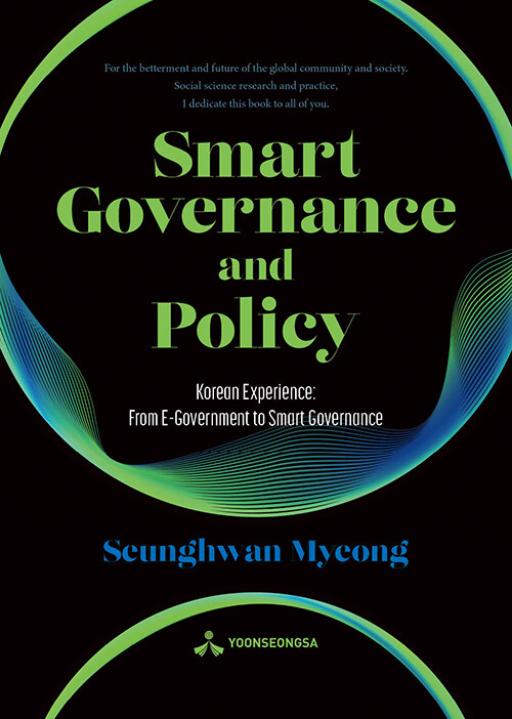
This special English-language edition tries to reflect as much theoretical and empirical research on the new changes in the digital transformation era as possible. It consists of 6 chapters and 1 appendix. Chapters have been added to reflect the advances and changes in new IT. Chapter 1 is the emergence and evolution of e-government, Chapter 2 is the foundation and support system of e-government, Chapter 3 is the understanding and direction of e-governance, Chapter 4 is the era of the 4th industrial revolution and future smart government, Chapter 5 is a smart city, Chapter 6 is artificial intelligence and public administration, Chapter 7 introduces the multi-dimensional decisionmaking model based on the"Quantum Probability Model," and finally, the appendix is meta(bus) government.
Finally, I thank the researchers and practitioners at the Center for Converged Security and Governance at Inha University and the Graduate School of Smart Governance and Policy for their academic and practical contributions to this book. I would also like to thank Jung Jae-hoon, CEO of Yoon Sung-Sa, for carefully reviewing the writing process with new ideas. Once again, I dedicate this book with all my heart to my beloved parents, my wife and son, my academic peers, and the researchers in my lab at Inha University.
July 2024
In the lab at Inha University, room 9-308
Seunghwan Myeong








 AD광고
AD광고 AD광고
AD광고